

Journey in Ink
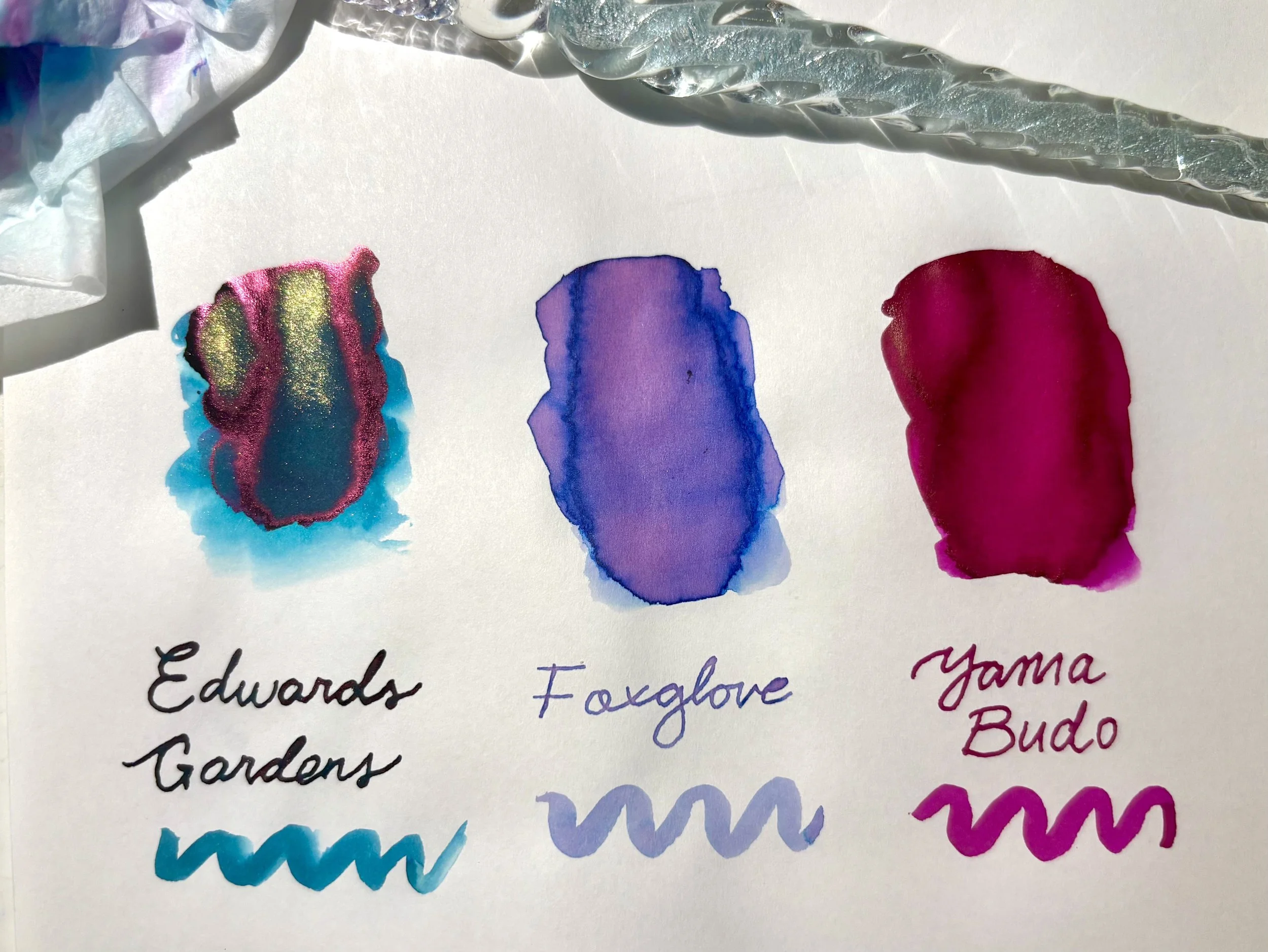
Swatches of some of my favourite colours on loose leaf sheets of Tomoe River paper
Hi there dear reader, and Happy New Years Eve.
I hope your day is going well so far! Thanks for taking some time out of your day to read this blog. Since this year is coming to an end, I’ve spent time reflecting on my journey with inks and pens since 2022.
I assume since you’ve clicked this post you perhaps like ink too? Let’s be ink friends.
In my other blog post I talked about my collection I’ve bought over the years, which totals a full drawer, 2 acrylic stands and 33 fountain pens to be exact.
Here are some of my favourite inks (Along with secondhand, very thorough reviews from the site “Mountain of Ink”, my favourite go-to place for reliable ink reviews and comparisons):
Edwards Gardens by Ferris Wheel Press (Now a discontinued ink! I could cry!)
Foxglove by Troublemaker Inks (despite being on the dry side I absolutely love this colour)
Purple Pazzazz by Diamine Inks (I’m a sucker for a purple and a gold, this ink has both to the MAX, I have to buy a new bottle soon as I’m currently fresh out)
Yama Budo by Pilot Iroshizuku (a beautiful deep fushia with sickly yellow-green sheen)
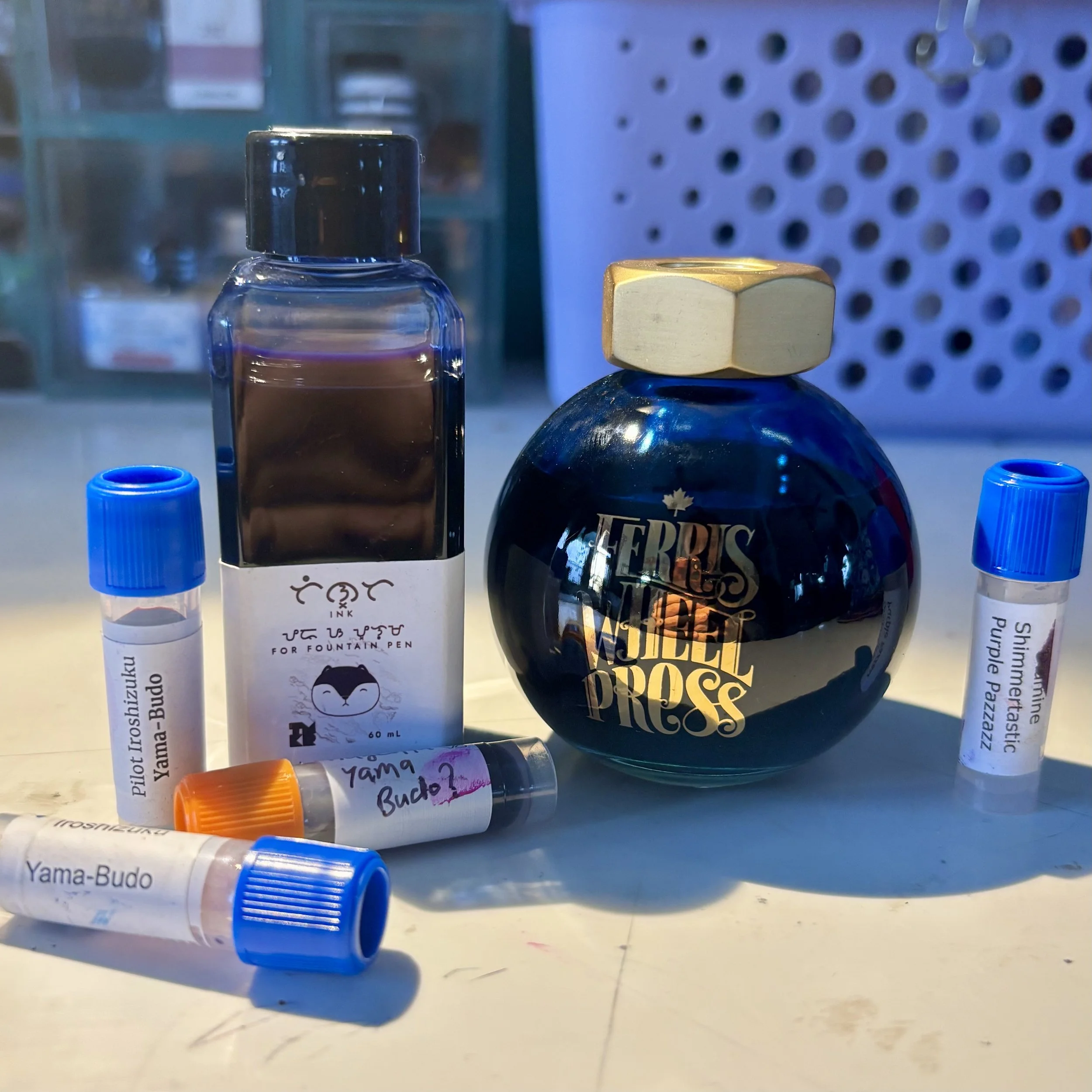
Some of my favourite inks! (Swatched at the top of the page)
I tend to gravitate mostly towards purples, blues, teals and pinks for my writing inks. I particularly love shimmer and shading inks as I find them the most visually interesting.
For my pen of choice I love writing with a 1.1 stub nib by twsbi or a generally a broad or medium nibbed pen. I like a fatter nib over a finer one because a lot of the inks I enjoy are best used when more ink meets the page.
Some of my most used pens are my:
TWSBI swipe 1.1 nib and TWSBI diamond mini (made in Taiwan)
Lamy AL-star with a medium nib and Lamy safari (made in Germany)
Esterbrook JR with a broad nib (designed in the USA, made in Taiwan)
Ferris Wheel Press Bijou in medium (Canadian based!)
Pilot Kakuno in medium (Japanese made)
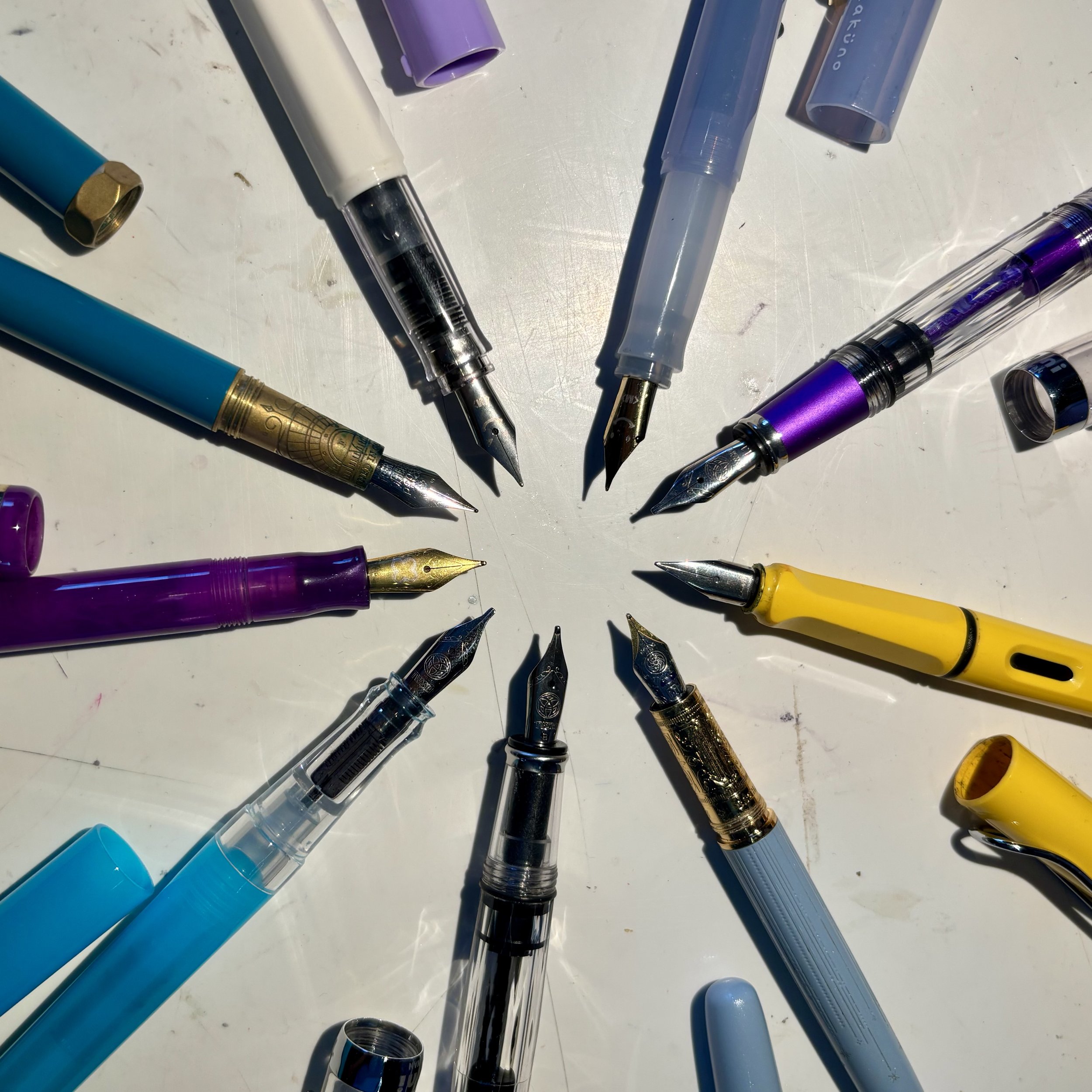
My most used pens, from TWSBI, Lamy, Pilot, and Ferris Wheel Press
It can be a tricky balance between showing the colour of ink enough and “feathering” - a term used to describe when ink bleeds into the page, reducing the crispness of lines and creating a fuzzy or featherlike outer edge. An effect that is not so desired when it comes to writing, as it can disrupt legibility and overall polish. This can happen when the consistency of the ink is too thin, the paper is too absorbent, the paper is made with larger pieces of fibre or the nib of the pen is too thick for the type of paper you’re using.
If you encounter feathering, you may want to switch your paper, ink, or nib to find a better fit.
This year I bought a book from my local book store called “MAKE INK” by Jason Logan. The demanding title of the book and the swatches of ink on the cover caught my eye immediately. As a keen lover of buying ink I was immediately drawn to the idea of making my own. I had half the battle down already - mostly understanding colour theory. What I didn’t have a great grasp of is chemistry, the other major component of making ink. This book had step by step recipes, like a cookbook but for making your own colours. After reading that book I looked at the world differently. Appreciating and admiring colours on a different level and looking at materials around me and how to make them into ink.
“What colour would that make?” was the main question in my mind.
So I began an ink log.
It was the summertime, so raw materials were abundant like flowers, leaves, and berries but it doesn’t stop there. I tried burnt logs, rusty metals, walnuts and more strange materials I could get my hands on. Most of the inks I could make weren’t safe for using in a fountain pen, unfortunately. But made great drawing and dip pen ink.

My ink recipe logbook
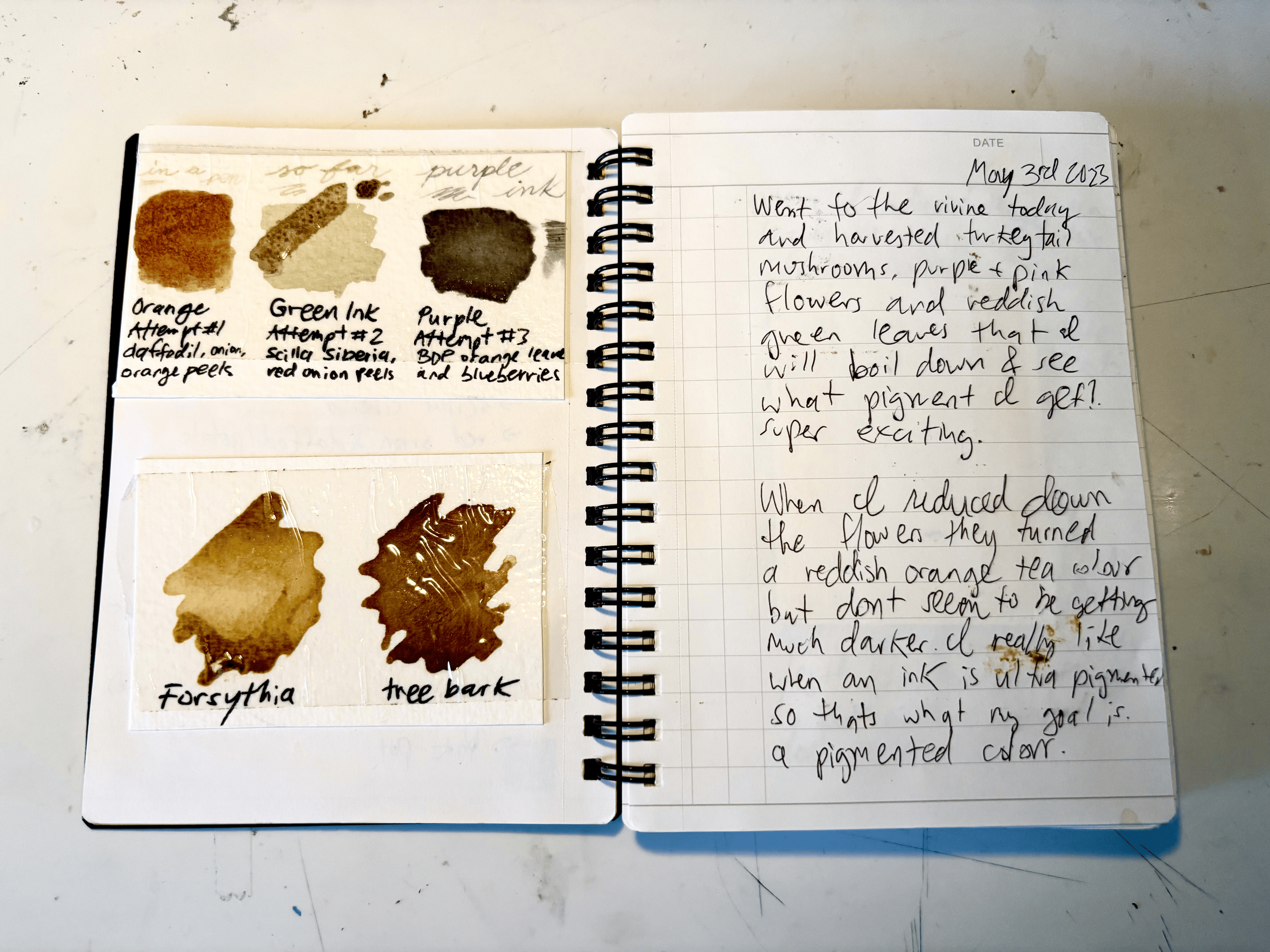
A page from my Ink book
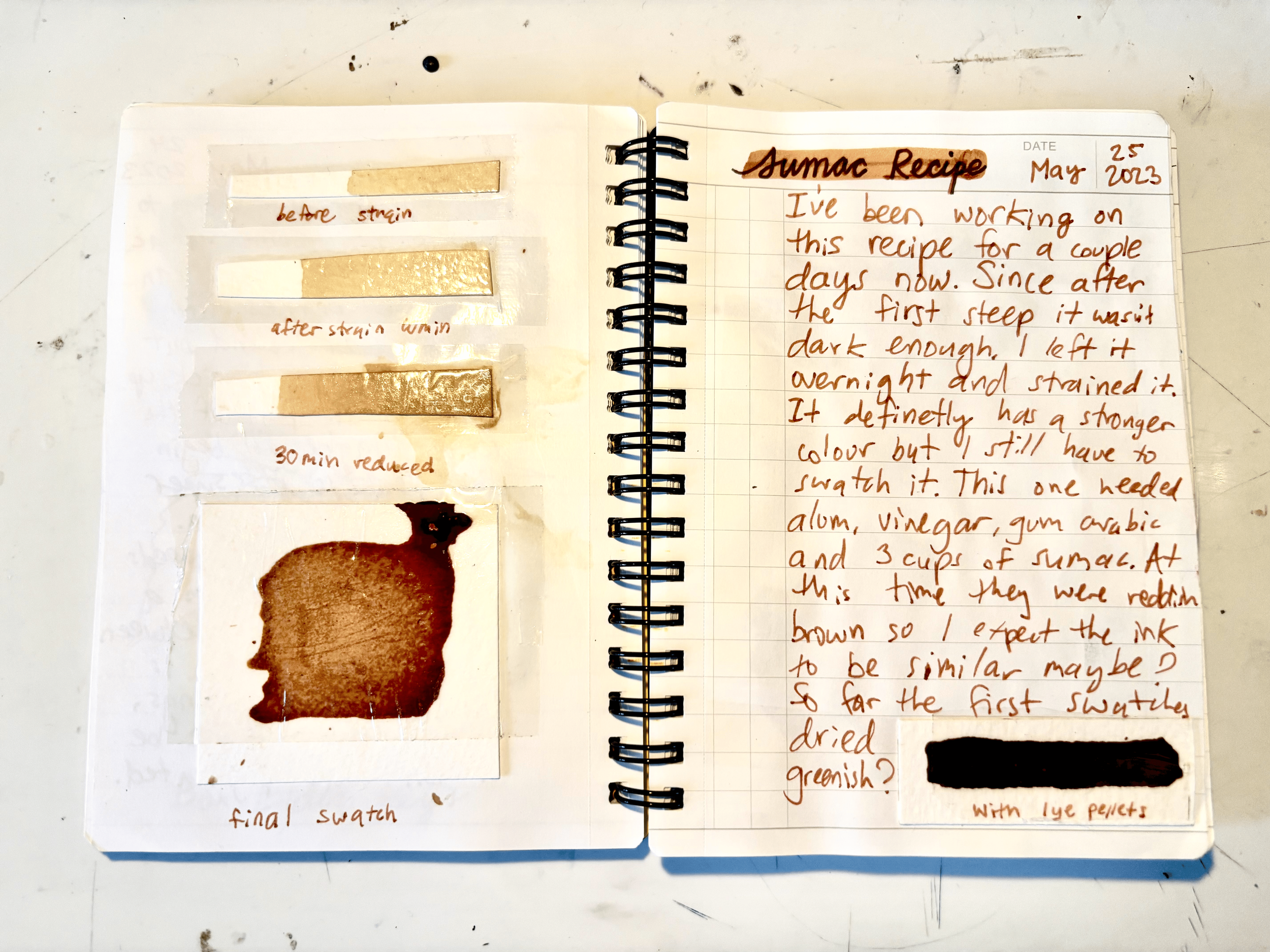
Sumac ink testing
I also got another book. Called “The Secret Lives of Colour” that opened my eyes to the history and meaning behind colour. There were many pigments that were so expensive and coveted because they were so incredibly hard to make that only the supremely wealthy would be able to afford a painting using those materials - for example Tyrian Purple (a single ounce of dye took 250,000 murex and Thais snails) or Ultramarine (back when it was made with authentic lapis lazuli powder, a very expensive type of rock).
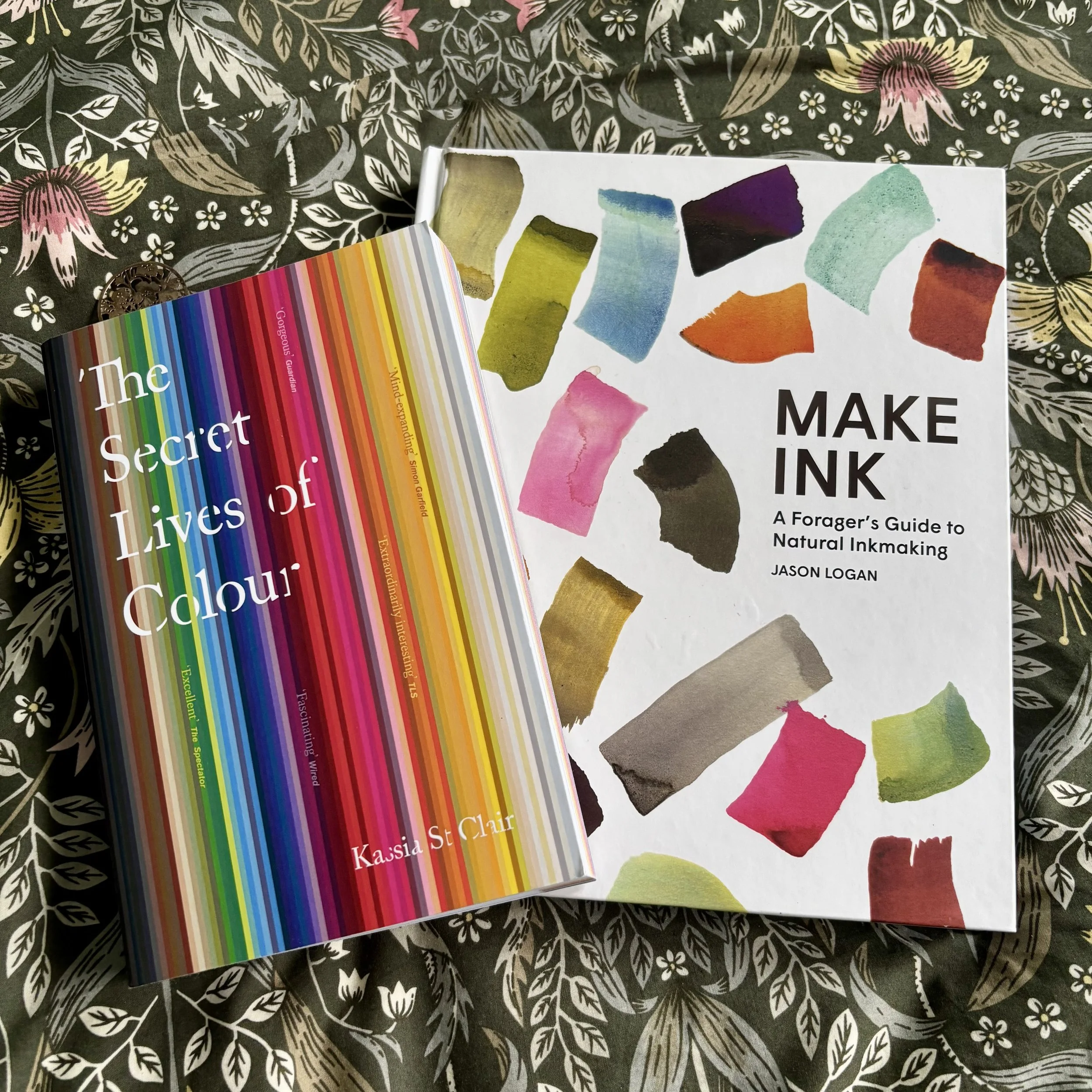
The Secret Lives of Colour by Kassia St. Clair & Make Ink by Jason Logan
I highly recommend taking a read through these books if you’re interested in colours, paint or ink. There’s also a documentary you can watch on Netflix by Jason called:
“The Colour of Ink” that you can watch for free here.
I think everyone should get a fountain pen, a bottle of ink, some good paper and just play. Write. Draw. Appreciate. Have fun.
I truly miss going out to paint in the summer time. I brought my Moleskine watercolour sketchbook backcountry camping last summer and very much enjoyed painting things around our campsite. I brought a few of my fountain pens with a limited amount of inks since we had to carry and portage all our belongings.
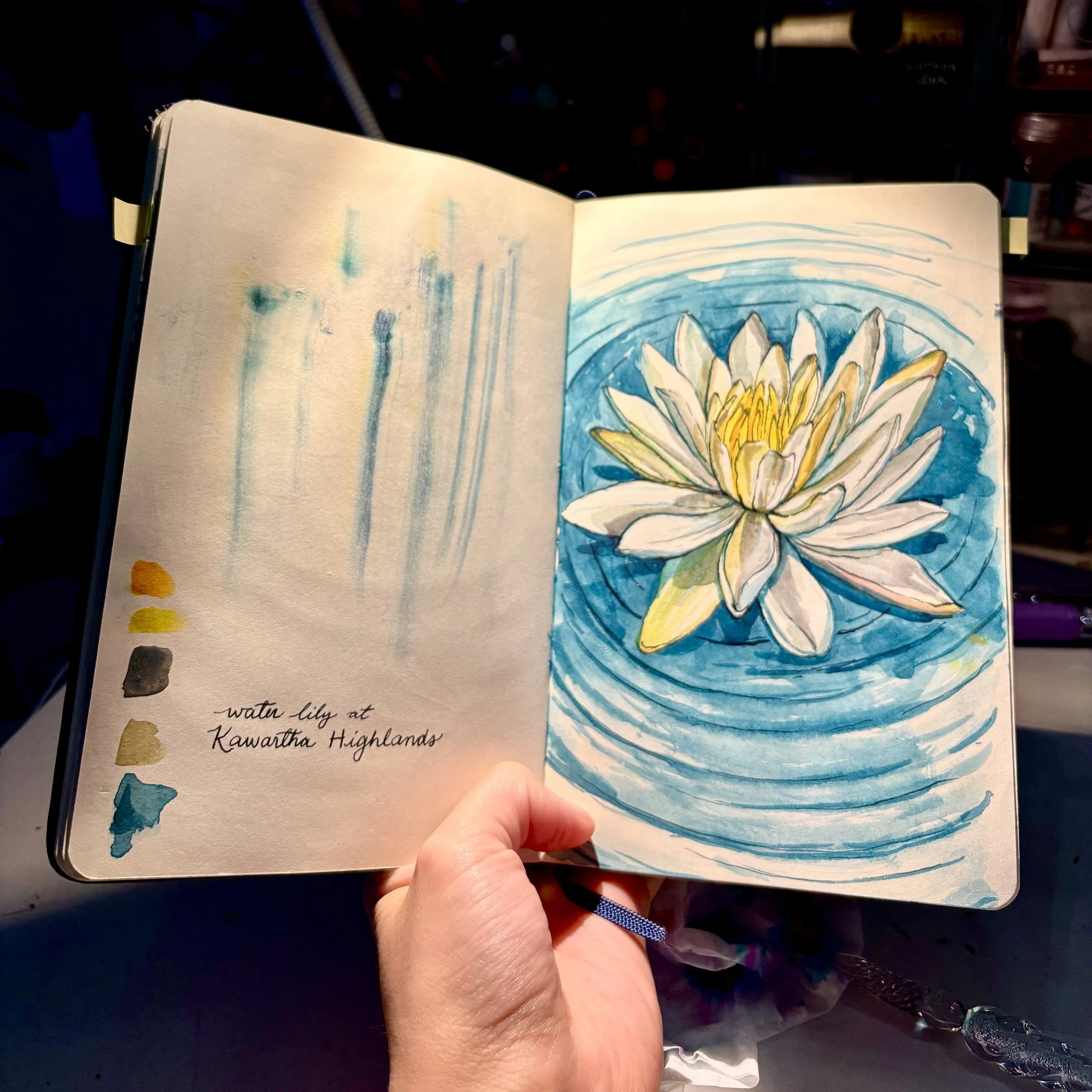
Water lily at Kawartha Highlands
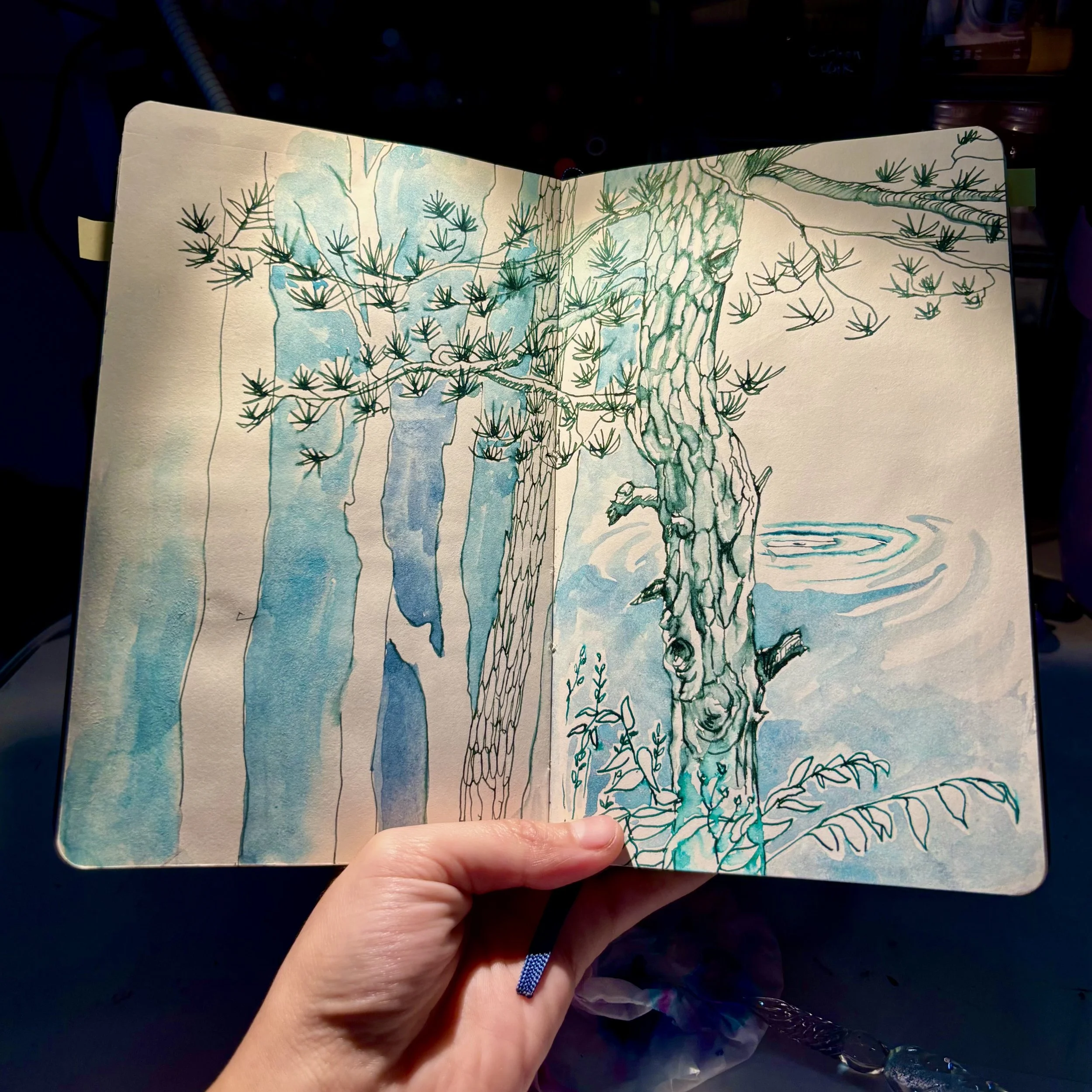
Trees by the water
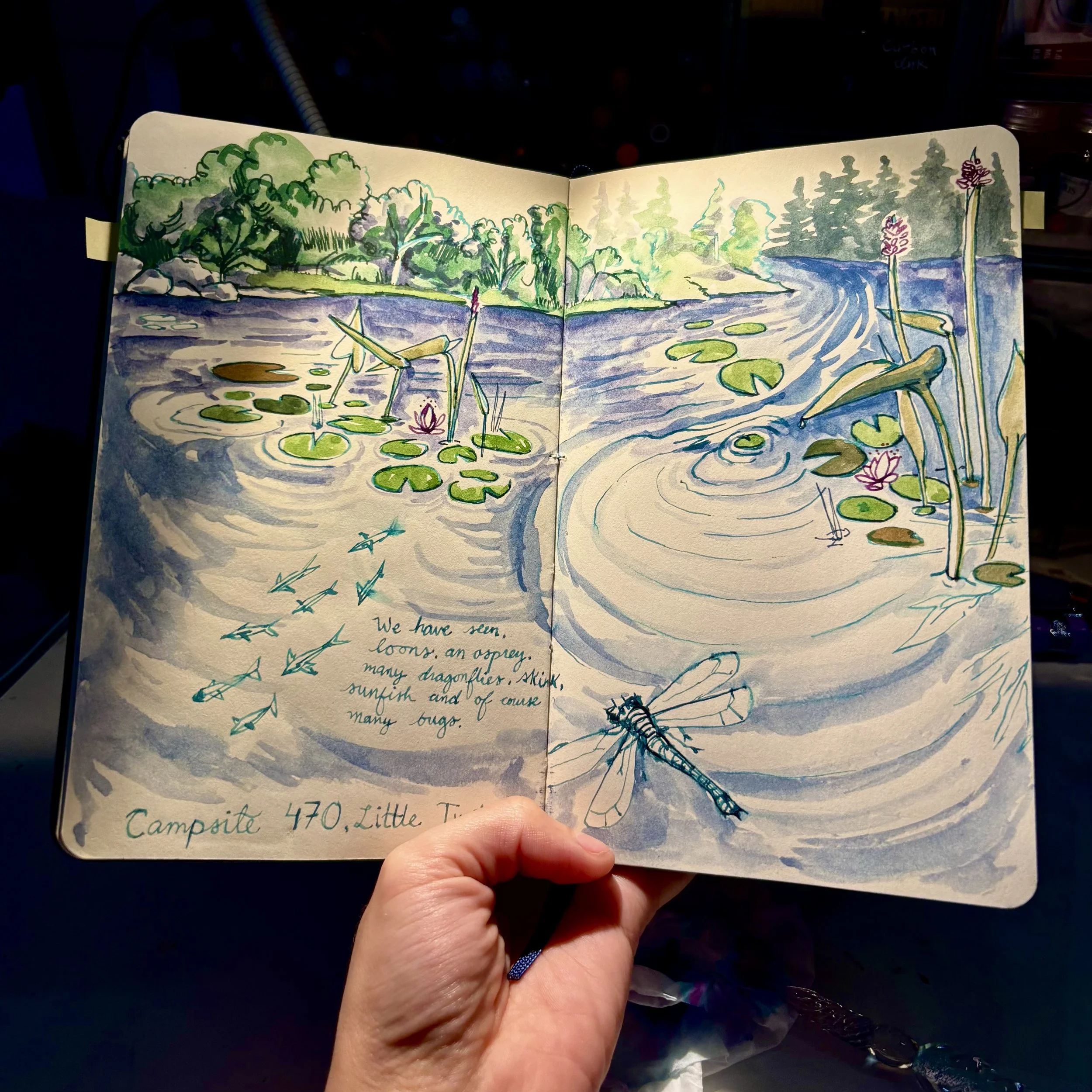
Little Turtle Campsite
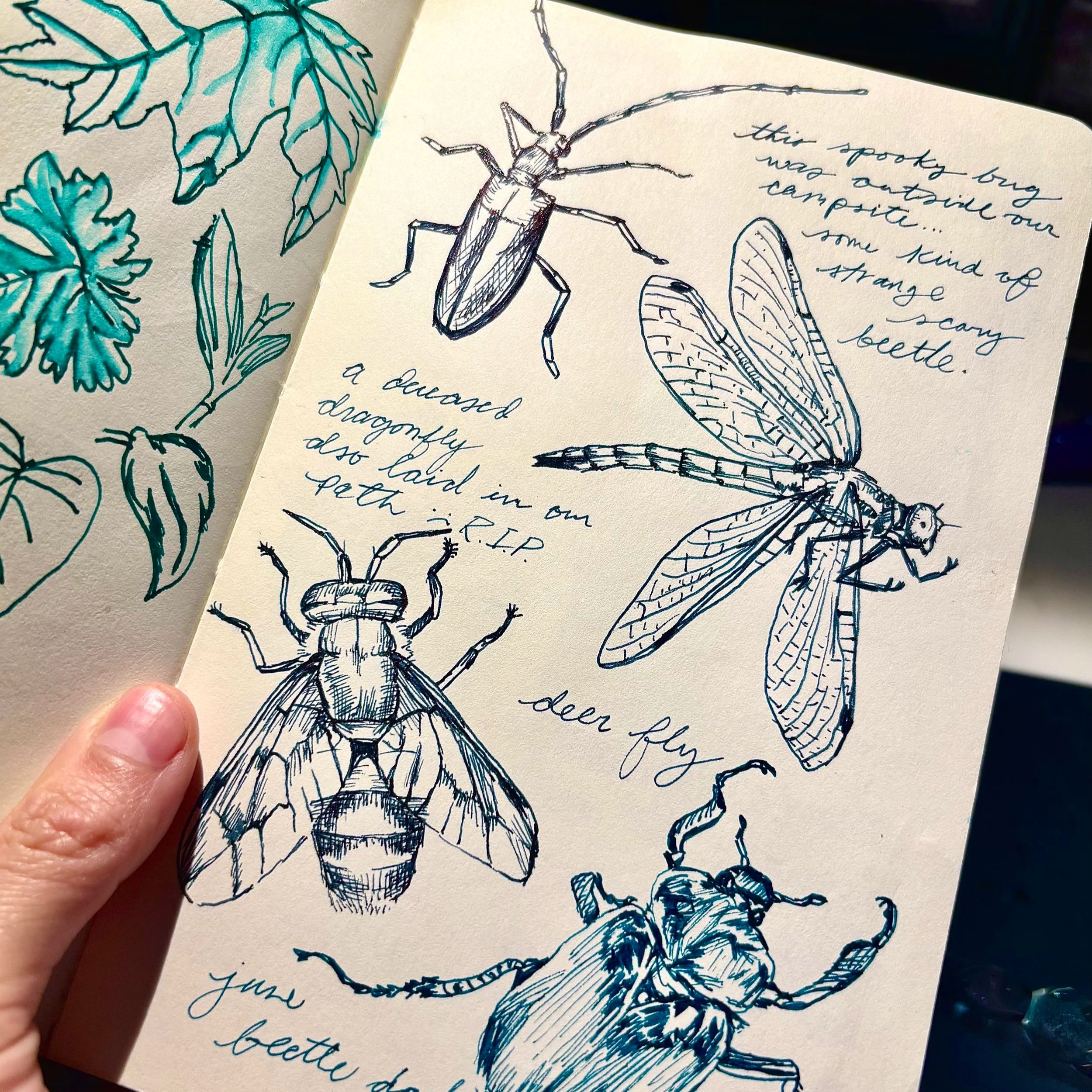
Bugs around the campsite
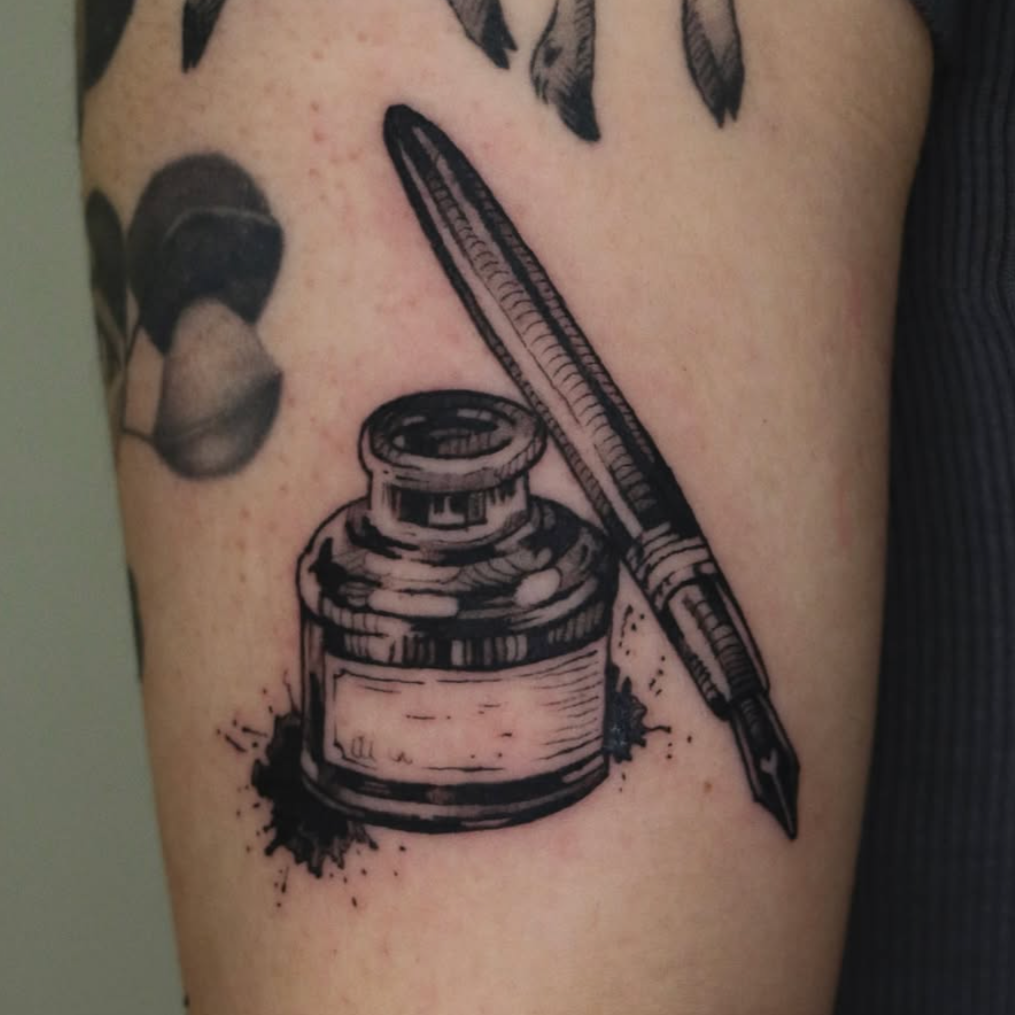
Inkwell and fountain pen tattoo on my arm by my talented tattoo artist friend, Monqiue Parlevliet @baldpeaches
I hope you enjoyed reading this entry about my ink journey. If you couldn’t tell ink has become a big part of my artistic expression that has only grown since I began the hobby.
It’s now permanently engrained in me after all, much like my tattoo on my arm.
Have a very Happy New Year!

